Allegory · Fantasy · Full Reviews

The Dragon and the Stone by Kathryn Butler

Finding a clean, wholesome, and creative new book series for children can be challenging in this day and age, and much more so if you would like to incorporate Christian Fiction with sound messages. I stumbled across a new series that (if book one is any indication) ticks all the boxes! I haven’t written any reviews in quite some time… I may have to do a few typing exercises and shake the cobwebs off the blog, but bear with me!

The Dragon and the Stone is the first book in the Dreamkeeper Saga by Kathryn Butler. The series opens with 12 year old Lily McKinley discovering a dragon in her kitchen. Shortly later she is whisked off to another dimension– a dream world filled with characters and animals that are brought to life by the imaginations of people back home. The premise allows for almost limitless creativity and fun, so expect plenty of beautiful and unusual creatures, places, and people. Not everything is unfamiliar, though; you’ll also run into incarnations of beloved literary favorites like Robin Hood and Lancelot.
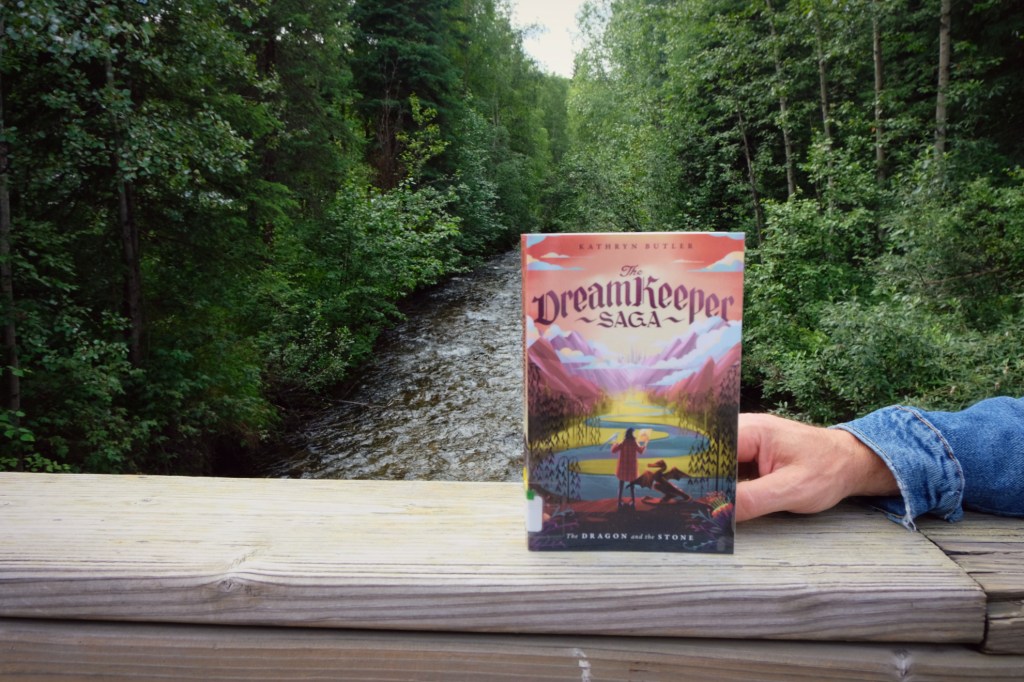
How this new dimension has its origins in the Garden of Eden is a really clever (if, of course, totally fictitious) idea, but I don’t want to give away too much. Jesus makes appearances in an allegorical way (think Aslan in Narnia). That said– perhaps not wanting to seem to steal from C.S. Lewis’ works–Butler presents Christ as a magnificent unicorn. This is something I felt slightly uncomfortable with, for reasons I have been trying to work out. Perhaps it’s just easier to accept Aslan the lion as a picture of our Savior because God already describes himself as a lion in Scripture, and I think we need to be very careful to depict God only as He has revealed Himself or His character. That said, I can’t think of a lot of other animals God compares Himself to that the author could have used allegorically– a lamb or an eagle come to mind. I guess I will need to make a study of pictures of Christ/God in the Bible! Interestingly, I’ve since learned that in the middle ages unicorns represented the incarnation of Christ and were symbols of purity and grace.

Some aspects of the story felt a bit flat to me– the characters and dialog could use a bit of fleshing out– but I’m hopeful now that the premise has been established the sequels will be able to expand and improve on those difficulties. Overall, the story had me on the edge of my seat– the author did an excellent job creating a sense of adventure and possibility! This book would make a PERFECT read-aloud– short chapters, with lots of suspense. Not to mention opportunities galore to try your hand (voice?) at accents– pirates, dragons, knights, — even Merlin makes an appearance.
I’m giving this a hearty 4 stars rating and have high hopes the the rest of the Dreamkeeper Saga will attain to a perfect 5. Do you have other children’s Christian Fiction recommendations I should try? Also, does anyone recognize the train in the first cover photo? Tell me if you’ve been there too or would like to hear about it. Happy reading and summer adventures!

Allegory · Full Reviews

Full Review, The Book of Told

“Where were you when I wrote the first words of this story? Tell me if you understand. Who marked out its chapters? Surely you know. Who stretched the story arc across it? On what were its structures set, or who laid the first cornerstone?”

~The Author, when Brew accuses him of being responsible for the painful death of his brother.

What if you found out you were just a word in an author’s book? That this world was His creation and story, but that he had given you free will to decide what kind of character (word) you would be? What if the author penned himself into his own story and promised that those who were words of life in his book would be granted to become ‘real’ at the end of the final chapters, and live in reality with him? What if in six years, you and the inhabitants of your valley experienced an allegorical version of nearly all of human history?  This is The Book of Told: Mere Words.

No matter how I summarize K. A. Gunn’s work, I feel as if I am swaying back and forth between either over-simplification or representing it as extremely complicated. While it is unique in concept, it is not entirely hard to understand or follow – just challenging to describe. You could almost imagine that it is like Pilgrim’s Progress, if Pilgrim made his journey as a Christian but was also traveling through world history, in addition to his own life. However, unlike Pilgrim’s Progress— or even Hind’s Feet in High Places— the main character is relatively stationary in his valley and the narrative involves all the things taking place between the different people who live there.

The language and plot-line of The Book of Told are much easier for me to follow than the aforementioned allegories, given that it was written in a modern-day style and vernacular. Human history doesn’t always condense down into the smooth pacing desired in fiction, so the story can at times feel… fragmented. That said, Gunn does a decent job of weaving the main character’s life through the larger picture to hold it all together and keep things moving. (Side thought… have any of you read Ted Dekker’s Black? This reminds me of Black’s “other reality”, but a lot less fantastical/outlandish.) Like many allegories, there are plenty of “theological pauses,” where the characters stop to discuss or try to wrap their minds around ideas, such as creation vs. evolution or the dangers of entertainment.

What the book lacked in a few minor ways I’ve already mentioned, it more than makes up for by practically fulfilling the very definition of ingenuity: the quality of being clever, original, and inventive. Gunn employs a lot of wordplay and wit, and some of it borders on genius. But ultimately, what I love about this book is that it doesn’t draw attention to itself, but to our Lord and His brilliance.

At times quiet and reflective, at other times (especially in the second half) full of action and conflict, I would recommend this book to anyone who’s been a Christian for some time. It can be difficult to draw out the parallels and soak up the meaning–frankly, I’m still scratching my head and wondering what a lot of the symbolism stood for. I recommended it to my Pastor, and perhaps he will point me in the right direction; notwithstanding, I can easily see myself re-reading this treasure in the near future to see if I can glean some more goodness from the details I glazed over. When I do, or if I alternatively discover something I disagree with upon understanding the meaning, I would love to write up another post to share my findings.

History lovers, allegory readers, and English language devotees, I hope you grab a copy, and be encouraged that the author pledged all the royalties from your purchases to the A21 Campaign, a non-profit which works to end human trafficking and slavery.

To close, which Christian allegory do you think you’ll be more likely to read next; this one or Hind’s Feet on High Places (review here)? Let me know in the comments.

An arrow zinged too close, and I held up my shield swiftly to stub it. Cheers of approval rang out behind me. Still, Told held us back from the attack.

This time, an Untold phrase charged madly into the dome with weapons aimed. “Between ignorance and intelligence!” they shouted their war cry.

Startled they would claim intelligence, given their name, I laughed tensely. Again, they ran by us to attack Som, Duso, and Reson on the stairs. Again, we shouted tribute. “Fear of the author is the beginning of wisdom!”

– Chapter 59

Disclosure for readers– I should note that a mild swear word is used near the beginning of the book when a character grieves the death of a family member. It is not used in any passage thereafter.

Allegory · Full Reviews

Full Review, Hinds’ Feet on High Places

HINDS'Feet1

Hinds Feet on High Places
by Hannah Hurnard
Tyndale Publishers

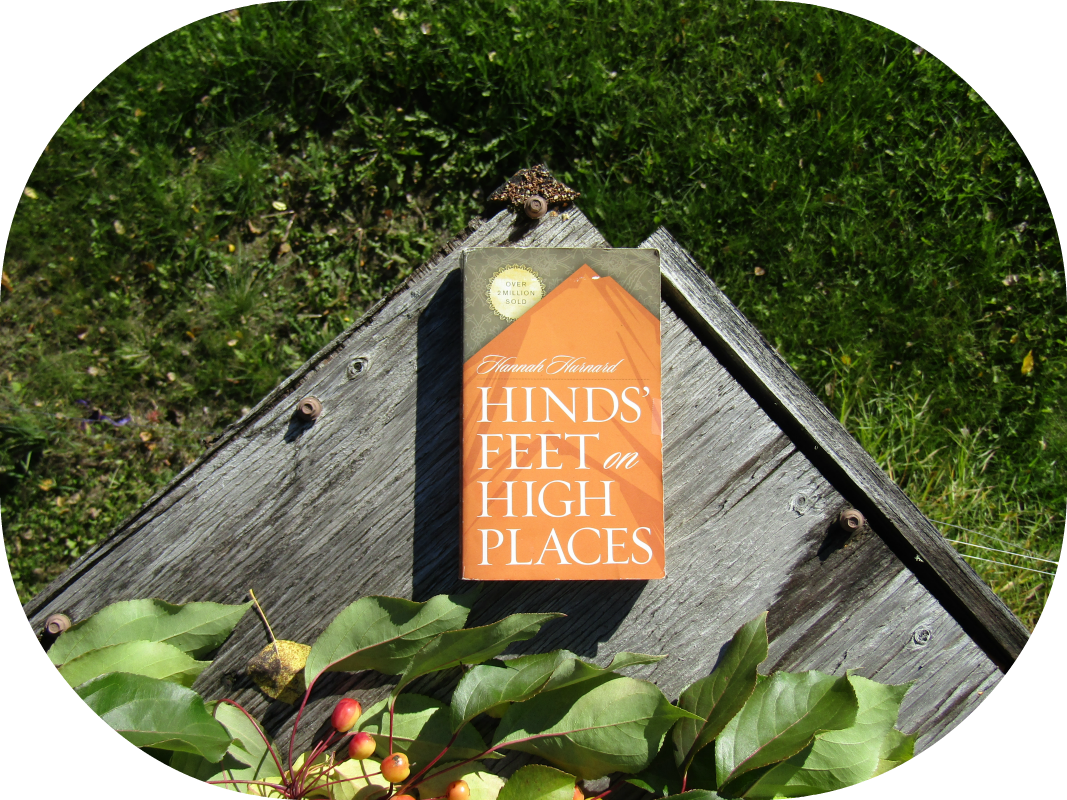
I gave you a sneak peek of Hinds’ Feet on High Places a few weeks ago (you can find that here). In case you missed that post, Hinds’ Feet is an allegory detailing the journey of little “Much-Afraid”, a crippled and disfigured young woman following the Shepherd up to the High Places. In my interpretation, the High Places do not represent Heaven and the end of earthly life, but rather the reaching of a deep spiritual relationship with God which continues to grow. Continue reading “Full Review, Hinds’ Feet on High Places”